
What Is Industrial Catering And Why It's Not The Same As Regular Corporate Catering
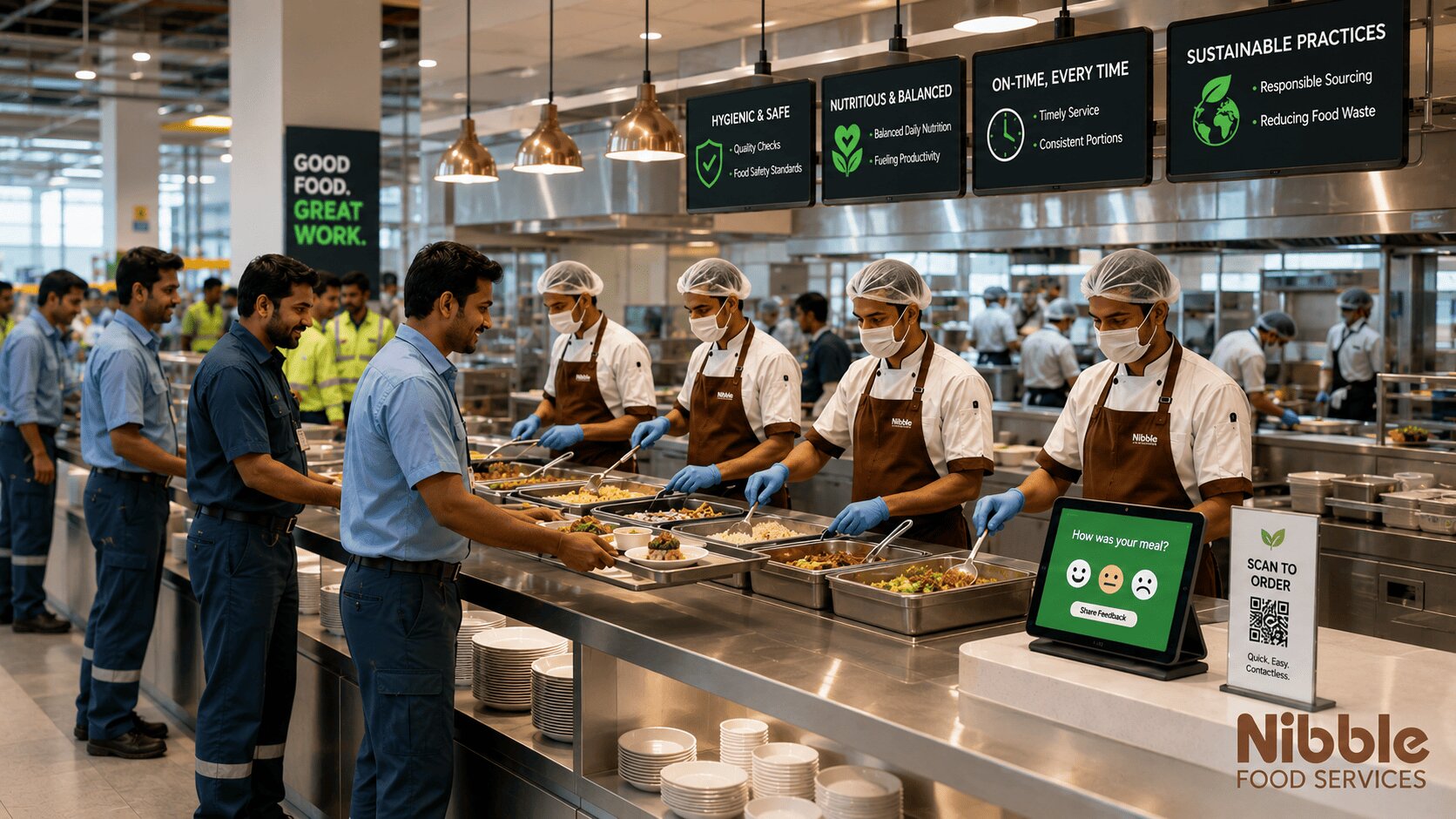
Ask most facility managers to describe corporate catering, and they'll picture an office cafeteria with buffet counters, a rotating menu, employees eating at their own pace between meetings. Industrial catering looks nothing like that, and treating the two as interchangeable is where a lot of food service contracts quietly go wrong. Industrial catering serves a workforce that burns significantly more physical energy, eats in fixed shift windows, and often has mostly fifteen minutes to finish a meal and get back to the floor.
Understanding that distinction matters whether you're a facilities head comparing quotes or a manufacturing unit planning your first managed food service. Here's what actually separates the two.
Industrial Catering Vs. Corporate Catering: The Core Differences
Nutritional design: Corporate catering menus are typically built around balance and variety. They ensure enough protein and carbs to sustain focus through a desk-based day, without leaving people sluggish. Industrial catering menus are built around sustained physical output. Workers on a production floor need meals rich in complex carbohydrates, protein, and fibre, calibrated to fuel manual labour across an 8–12 hour shift, not a meeting-heavy office day.
Timing and shift structure: A corporate cafeteria usually serves one core lunch window with some flexibility either side. Industrial catering has to work around rotating shifts. There are meals served at 6.00 AM, 2.00 PM, and 10.00 PM on the same day, often for entirely different groups of workers, with far less tolerance for delay since a factory floor doesn't pause for a late delivery the way an office might.
Meal format and speed of consumption: Industrial catering is engineered for short, fixed breaks. That means simpler, faster-to-eat formats, efficient serving lines, and packaging that holds up in a plant environment. It is not the same plated, browse-at-leisure format that works in a corporate cafeteria.
Scale of operational risk: When industrial catering serves hundreds or thousands of workers across a manufacturing or logistics site, food safety failures scale accordingly. This is why serious industrial catering providers operate understrict, auditable protocols with FSSAI compliance as the baseline, and often an ISO 22000:2018 food safety management system layered on top, covering everything from raw material sourcing to final dispatch.
Where Corporate Catering And Industrial Catering Actually Overlap
The two aren't entirely separate universes. Both depend on a strong central kitchen, both require rigorous hygiene standards, and both benefit from a provider capable of running customised menus rather than a single fixed thali. The difference is in what “customised” means in each context . It could be broadly dietary variety for corporate catering, physical-output-calibrated nutrition for industrial catering.
A provider that only understands one side of this often defaults to their comfort zone: office-style menus dressed up for a factory floor, which under-fuels a physically demanding shift, or heavy, canteen-style food pushed into a corporate cafeteria, which doesn't match a desk-based day at all.
Why This Distinction Matters When You're Evaluating A Provider
If you're sourcing industrial catering for a manufacturing unit, a warehouse, or a large-scale facility, the right questions to ask a provider are dfferent from the ones you'd ask for a corporate cafeteria:
- Can they run multiple shift-timed meal services in a single day, not just one lunch window?
- Do they have experience calibrating menus for physically demanding roles that include enough protein, carbs, and fibre for sustained output?
- What's their food safety protocol for high-volume, high-speed service, and can they show FSSAI and ISO 22000:2018 documentation?
- How do they handle temperature-controlled delivery and equipment sanitisation at industrial scale?
- Are there international-standard washing protocols (such as Cambro-based systems) which are a good marker of serious operational discipline here.
If a provider can't speak confidently to shift-based planning and physical-output nutrition specifically, they're likely applying a corporate catering playbook to an industrial catering problem. It is almost certain that it will show up in worker satisfaction and energy levels within the first few weeks.
Frequently Asked Questions (FAQs)
Q1: What is the main difference between industrial catering and corporate catering?
Ans: Industrial catering is designed for physically demanding, shift-based work. This means higher-calorie, higher-protein meals served in fixed, often multiple, time windows. Corporate catering is designed around a desk-based office day, with more emphasis on variety and balance than raw energy output.
Q2: Does industrial catering require different food safety standards than corporate catering?
Ans: The regulatory baseline (FSSAI) applies to both, but industrial catering typically serves larger volumes at higher speed, which raises the operational risk if hygiene protocols aren't strictly enforced. This is why ISO 22000:2018-certified food safety management systems are especially valuable for industrial-scale providers.
Q3: Can one catering provider handle both industrial catering and corporate catering contracts?
Ans: Yes, but only if they have genuine operational experience in both models. Ask specifically about their shift-based planning capability for industrial sites and their dietary customisation range for corporate offices. A provider strong in one doesn't automatically translate to the other.
Q4: How should meal timing be structured for industrial catering with multiple shifts?
Ans: Meal service should be mapped directly to shift start and break times. There are typically three distinct service windows for around-the-clock facility. This means the kitchen production will be scheduled to have food ready and temperature-controlled at each window, rather than a single large batch held over multiple hours.