
Corporate Catering vs. Managed Cafeterias: Which is Right for Your Tech Park?
Not all B2B food services are created equal. While 'corporate catering' and 'managed cafeterias' are often used interchangeably, choosing the wrong operational model for your tech park can lead to logistical chaos and budget overruns. As a facility manager navigating the complex world of b2b catering services, understanding the fundamental differences between these two models is absolutely critical for scaling your business. Both serve the primary function of feeding your workforce, but their execution, scope, and strategic value are entirely different. Deciding whether corporate catering vs managed cafeteria is right for your specific tech park food management needs depends heavily on your company’s size, infrastructure, and long-term workplace culture goals.
Let us first define the scope of traditional corporate catering. This model is generally transactional and event-driven. Corporate catering involves a vendor preparing food off-site, delivering it to your office, setting up a temporary buffet line, serving the meal, and then packing up and leaving. It is a highly effective, low-infrastructure solution. If your company is a rapidly scaling startup with under 200 employees, or if you simply need to provide food for a specific town hall meeting, a board lunch, or a weekly 'Fun Friday' event, corporate catering is the perfect fit. It provides flexibility without tying you down to complex daily operations. However, as a company grows, relying solely on daily drop-off catering can become monotonous for employees and administratively exhausting for HR teams tasked with constantly managing orders.
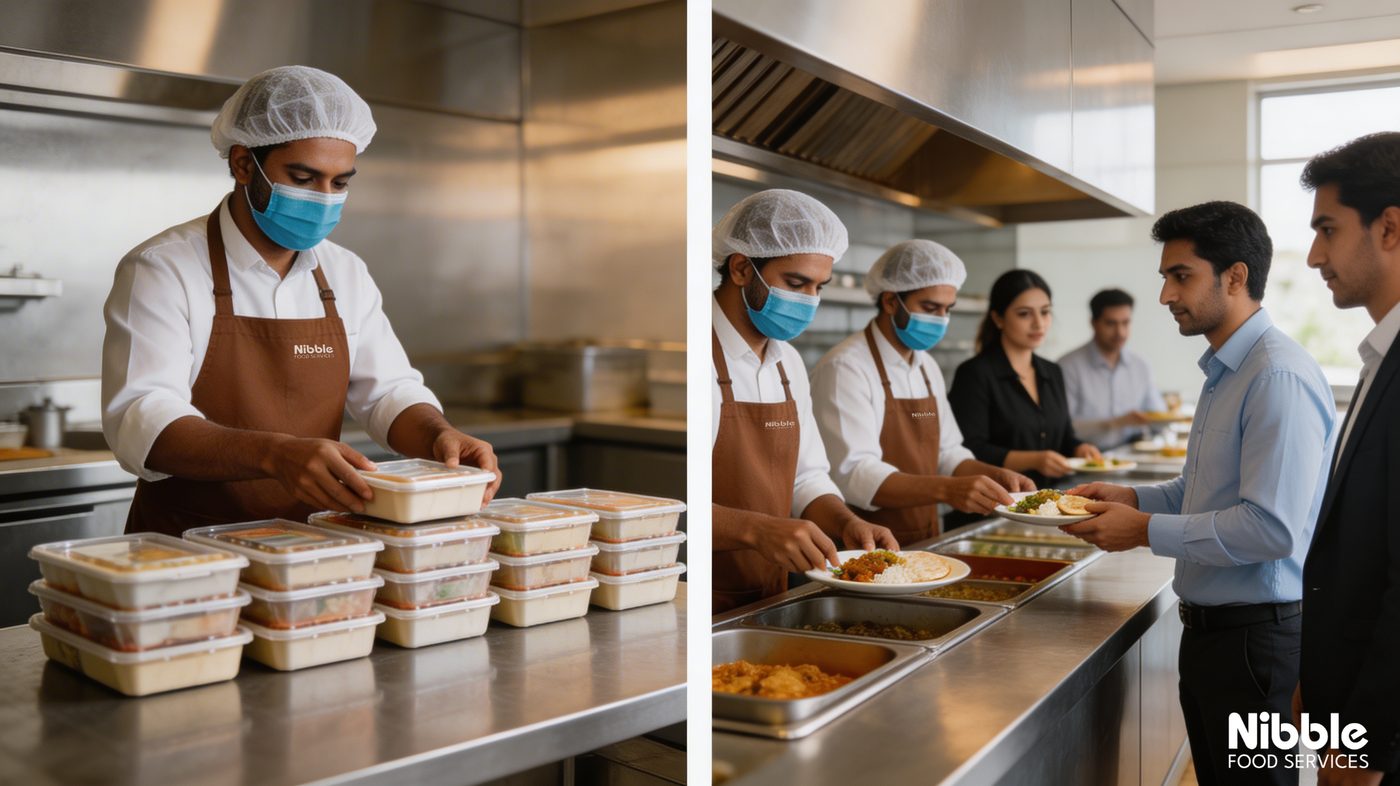
This is where the transition to a managed cafeteria becomes essential. Cafeteria management is not a transactional service; it is a comprehensive, end-to-end operational partnership. When you hire a provider for cafeteria management, they essentially take over the entire dining infrastructure of your building. They don't just deliver food; they manage the physical space, staff the serving counters permanently, implement rigorous daily hygiene audits, and handle all the backend supply chain logistics. This is the gold standard for large-scale tech park food management. If your campus houses 500 or more employees, a managed cafeteria provides the daily consistency, variety, and professional oversight required to run a high-volume food service smoothly.
One of the biggest differentiators in the corporate catering vs managed cafeteria debate is the level of customization and daily variety. A managed cafeteria operates much like a permanent food court. The management company will introduce distinct, rotating food stalls—perhaps a South Indian counter, a continental salad bar, and a live dosa station—giving employees massive daily choices. They utilize data analytics from Point-of-Sale (POS) systems to track consumption habits, phasing out unpopular dishes and introducing new office food solutions based on real-time feedback. Traditional daily catering simply cannot offer this level of dynamic, data-driven menu engineering.
Furthermore, the managed cafeteria model drastically reduces risk and administrative burden. In a fully managed setup, the b2b catering services provider assumes total responsibility for FSSAI compliance, staff medical certifications, and equipment maintenance. They implement advanced waste tracking systems and digital billing integrations, completely insulating the facility manager from the daily headaches of running a commercial dining operation. The facility manager transitions from actively micromanaging food deliveries to simply overseeing the high-level metrics provided by the cafeteria management partner.
Ultimately, deciding which model is right for your tech park comes down to scale and ambition. If you are operating a smaller, highly flexible office, traditional corporate catering provides the necessary agility. But if you are managing a massive campus and want to utilize food as a strategic tool for employee retention, productivity, and workplace culture, investing in comprehensive cafeteria management is the only logical choice. By understanding these distinctions, facility managers can implement the exact office food solutions required to fuel their workforce efficiently and economically.